Summary: Welding applications in industrial robots include spot welding, arc welding, and other types. From single-point welding to assembly welding, the complexity is increasing daily, and relying solely on manual teaching is no longer sufficient for daily needs, especially for assembly welding. So how does iRobotCAM, a domestically produced offline robot programming and virtual debugging software, consider the application of welding processes?
Welding applications in industrial robots include spot welding, arc welding, and other types. From single-point welding to assembly welding, the complexity is increasing daily. Simply relying on manual teaching is no longer sufficient for daily needs, especially for assembly welding, particularly in complex applications such as friction stir welding, which involves the comprehensive application of materials science, process engineering, and robot kinematics. This places higher demands on robot programming and simulation software. This article uses assembly welding as an example to demonstrate the product capabilities and considerations of iRobotCAM, a domestically produced offline robot programming and simulation software, in welding process applications.
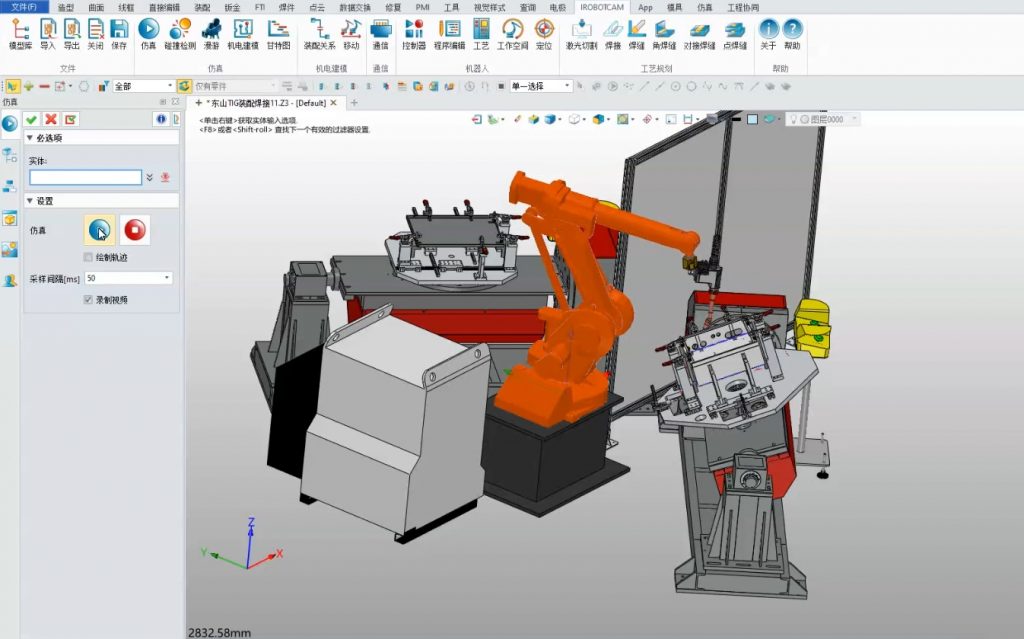
As an application of assembly and welding processes, the main difficulty lies in:
- There are many types of welding processes, making rapid matching difficult . The core of process application lies in matching the appropriate robotic process application based on the characteristics of the welding materials. This is especially true for friction stir welding, where welding processes need to be developed according to specific product requirements to meet those requirements.
- The programming learning curve for welding is steep . Operators of existing welding robots, already proficient in using the robots, urgently need simpler programming methods to rapidly improve programming efficiency.
- The integrated process for welding is weak. Because welding involves upstream and downstream data management, it is difficult to unify the management of welding documents and processing corrections between upstream and downstream processes.
In the past, the over-reliance on the integrated software capabilities of industrial robots significantly limited their application in complex welding scenarios, highlighting the challenges of assembly and welding processes. However, the emergence of offline programming software has made it possible to program industrial robots for welding in complex scenarios. As a representative of domestically developed offline robot programming software, how does iRobotCAM approach these complex application scenarios?
- iRobotCAM’s product development architecture boasts strong process scalability . Utilizing iRobotCAM’s process library, it not only meets the application needs of various welding scenarios but also provides portable algorithm integration methods. This allows for the rapid integration of optimizations for various complex new welding application scenarios, achieving integrated programming and simulation.
- iRobotCAM boasts exceptional ease of use . As a domestically developed offline robot programming and simulation software, iRobotCAM is based on the ZW3D 3D CAD geometry engine and adopts the unified operation logic of CAD software, enabling rapid programming and simulation with simple operation. Furthermore, due to its focus on ease of use from the initial product development stage, iRobotCAM has gained recognition from vocational school textbooks and students in the National Vocational College Skills Competition, and has also earned the approval of manufacturers and users through collaborations with robot manufacturers such as Guangzhou CNC.
- iRobotCAM boasts strong integrated management capabilities . Leveraging its 3D CAD foundation, iRobotCAM can read data formats such as Solidworks, Creo, Catia, STEP, and Parasolid. It can automatically extract geometric features such as weld seams, perform rapid collision detection, and establish a digital twin model of the weld. Through upstream and downstream interactions, it can quickly identify the welding process requirements and achieve integrated management of product welding.
Below is a video demonstrating assembly and welding using iRobotCAM, showcasing iRobotCAM’s assembly, welding, and simulation capabilities.
“The iRobotCAM R&D team has over 10 years of experience in the research and application of robot software. Based on their vision for the future development of domestic robot programming and simulation software, iRobotCAM is developed on a domestic 3D CAD geometry kernel platform, leveraging the CAD capabilities of 3D geometry to achieve extremely strong scalability for complex welding processes.”
“From the initial stages of product architecture development, iRobotCAM fully considered the complex application scenarios of domestic processes. It can quickly add targeted process requirements to achieve predetermined process needs. This is iRobotCAM’s core advantage that distinguishes it from many similar foreign products. We hope to fully expand the application boundaries of industrial robots and significantly improve their application efficiency based on the needs of complex welding scenarios for industrial robots in China.” This is the product positioning of iRobotCAM by the founding team. Through continuous product innovation and integration with local welding applications, iRobotCAM aims to enable domestically produced robot programming software to better serve practitioners in various welding applications.
About Yueqing Technology
Yueqing Technology is committed to creating the open iRobotCAM robot offline programming platform, which is a digital solution integrating production line electromechanical concept design, robot processing programming simulation, and virtual debugging.
iRobotCAM website: www.iRobotCAM.com, Contact email: cooperation@iRobotCAM.com