Abstract: Load capacity is a core capability of robot dogs and a key focus of training and simulation to meet the needs of various application environments. This paper uses iRobotCAM embodied intelligent design software as a tool and Yushu robot dog as an example to illustrate how to implement the load design of robot dogs and generate a model based on robot kinematics architecture to meet the training and simulation requirements of robots.
iRobotCAM, a company deeply involved in embodied intelligent design industrial software, has won high praise from leading humanoid robot companies and dexterous hand companies. Its core technical architecture is based on CAD 3D geometric architecture. Targeting the field of embodied intelligence, it connects design at the top and simulation at the bottom. Its skeletal joint design architecture can realize the rapid design and generation of kinematic architecture models and is compatible with various simulation software such as ISAAC SIM and Open SIM.
Robot dogs are a widely used form of embodied intelligence. Leading robot dog companies such as Unitree Robotics and CloudMinds have launched various robot dogs for the power industry. However, different user scenarios require different robot dog capabilities, which necessitates scenario-specific training for the robot dogs, with load capacity training being the most crucial aspect. Below, we will demonstrate the overall process of load design and dynamic model generation step by step.
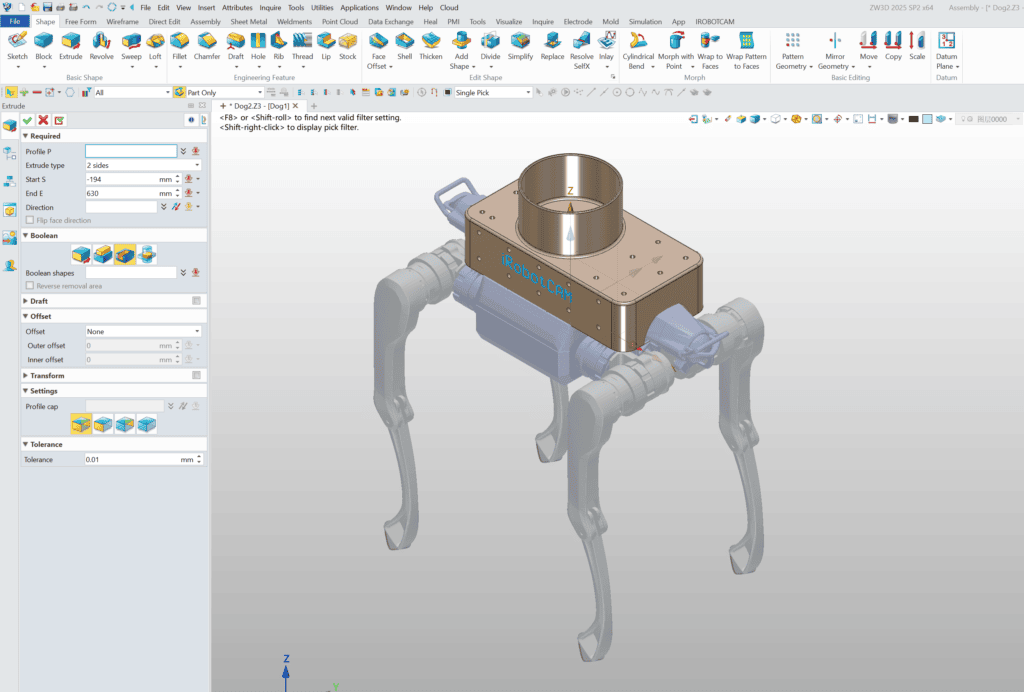
1. iRobotCAM, based on a 3D geometry kernel architecture, can import data formats from various 3D software, including Catia, Solidworks, NX, Creo, and Inventor. By importing multiple robot dog files, a 3D structural diagram of the robot dog can be created in iRobotCAM . Using the 3D modeling capabilities of the ZW3D platform, the robot dog’s load structure can be designed.
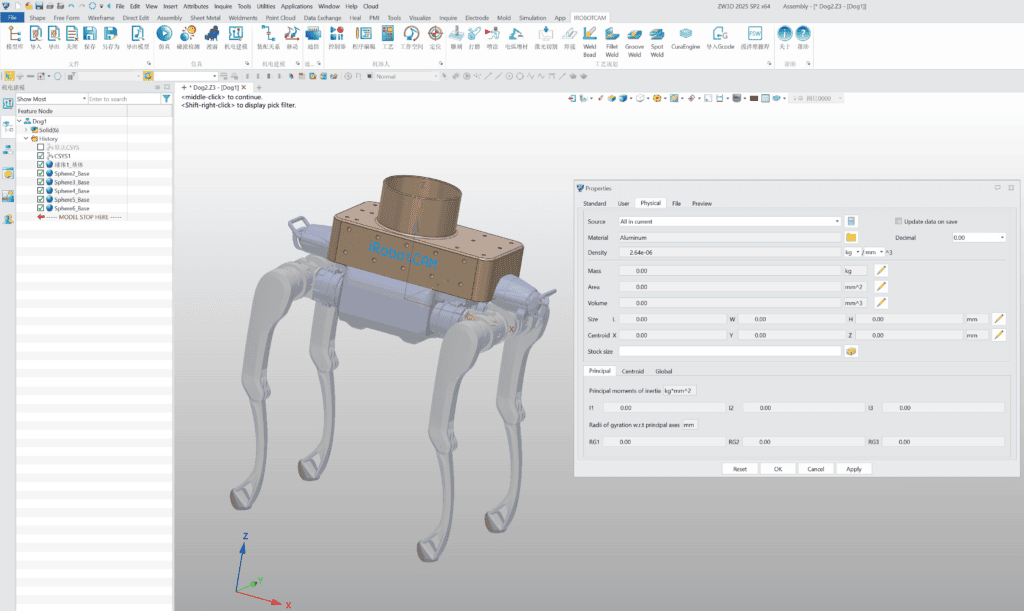
2. Utilizing convenient assembly management functions, material properties for each part can be quickly set, and physical characteristics such as inertia can be calculated.
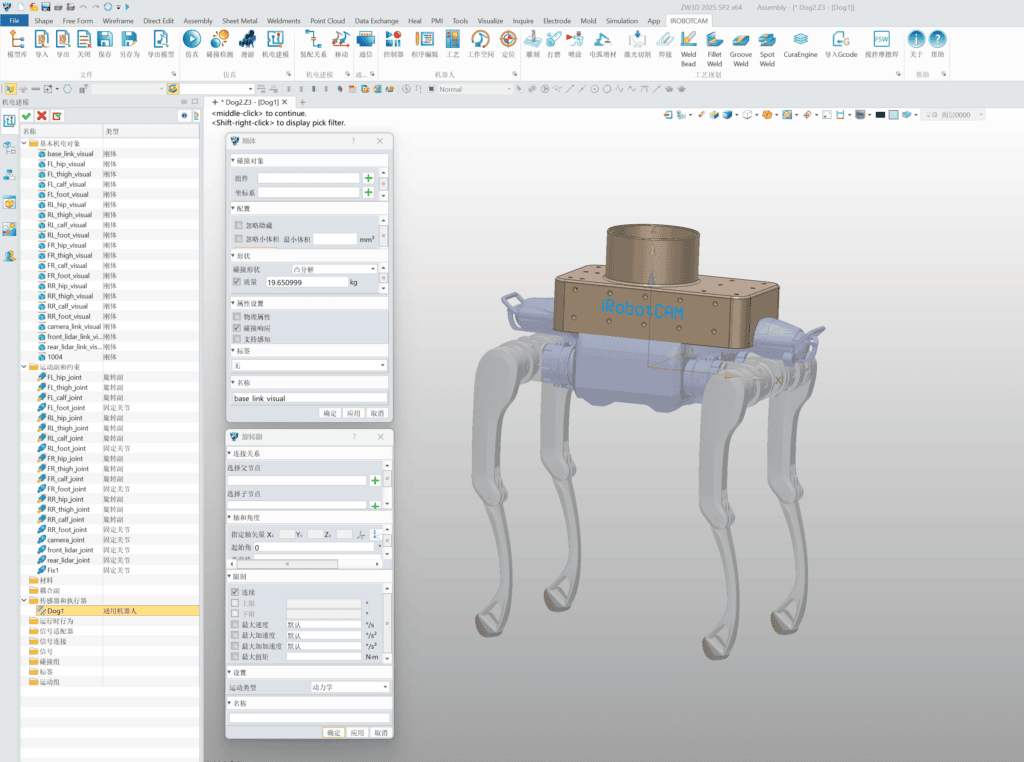
3. iRobotCAM, as a professional robot design and simulation software, can create electromechanical objects and kinematic pairs using its electromechanical design functions, including collision detection.
4. Utilizing a convenient skeletal-style robot joint design panel, all joint mechanisms of the robot can be connected to form a complete embodied intelligent general-purpose robot.
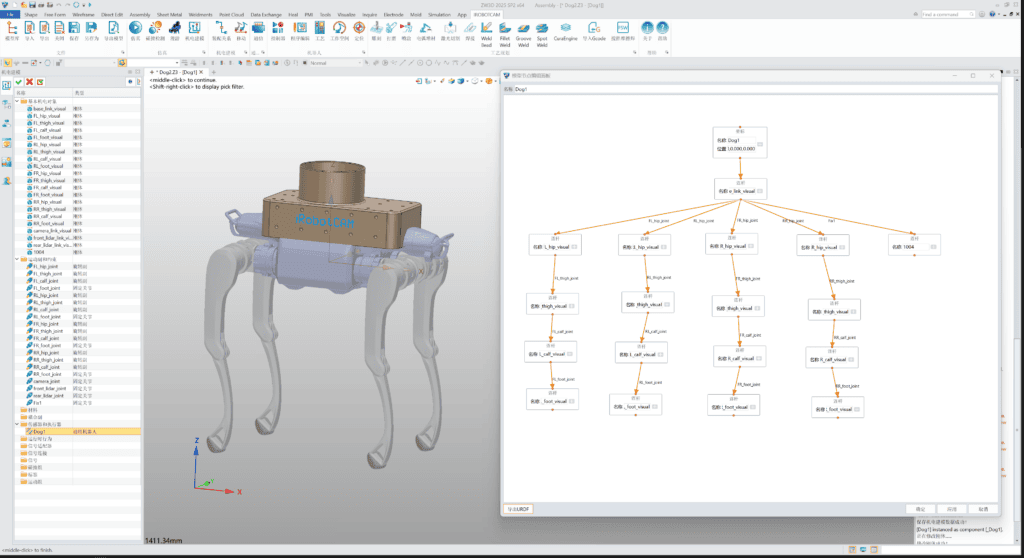
5. Utilizing iRobotCAM’s convenient URDF import and export functions, it can generate universal URDF files or MuJoCo XML files to seamlessly connect with the simulation needs of mainstream biomechanical engines such as MuJoCo, Simbody, OpenSim, and Isaac sim.
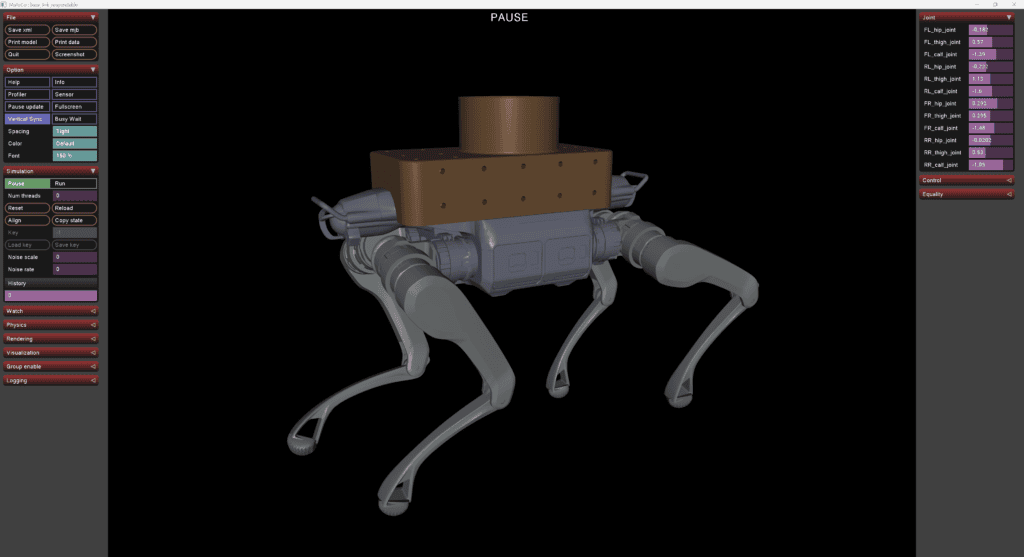
Using the iRobotCAM embodied intelligent design tool, modifying robot dog models is no longer cumbersome. A complete dynamic model can ensure the accuracy of data at the data source, greatly accelerating the simulation training efficiency of robot dog application scenarios.
About Nanjing Yueqing Information Technology Co., Ltd.
Nanjing Yueqing Technology is committed to creating the open iRobotCAM embodied intelligent robot design and simulation platform, which is an integrated solution for embodied intelligent design, electromechanical design, offline programming, and virtual debugging.
iRobotCAM website: www.iRobotCAM.com, contact email: cooperation@iRobotCAM.com